
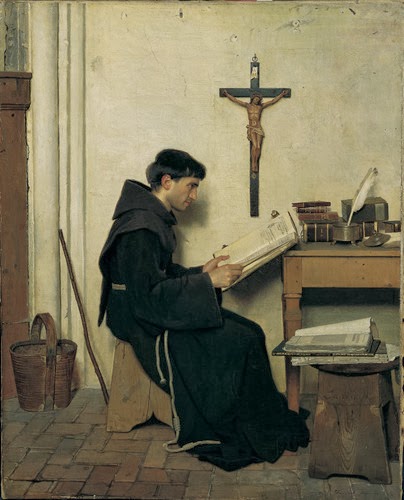
One of the old understandings of the Church was extra ecclesia nulla salus (outside the Church there is no salvation) where ‘church’ was understood to be the Roman Catholic Church, most fully in which, according to Lumen Gentium, ‘subsists the Body of Christ’ (LG 8). So outside the Catholic Church there was no salvation. However, this understanding of the Church and Lumen Gentium’s understanding of the Church demonstrate how doctrine and dogma grow and develop and salvation and redemption are no longer quite as elite and exclusionary as nulla salus would make them out to be. Lumen Gentium also states that Christ is the ‘light of the nations’ (LG 1) and is present to ‘each and every person’ coming into the world and enlightens them. This presence of Christ as the light to each and every person is echoed again in Pope St John Paul II’s encyclical Redemptor Hominis where he writes:
We are not dealing with the ‘abstract’ man, but the real, ‘concrete’, ‘historical’ man. We are dealing with ‘each man’, for each one is included in the mystery of the Redemption and with each one Christ has united Himself for ever through this mystery (RH 13).
Those of us who are Franciscan will feel our eyes drawn to the terms ‘abstract’, ‘historical’, ‘concrete’, ‘each’, for these terms call to mind Scotus’ concept of ‘thisness’ (haecceitas) wherein whatever individual thing exists in the concrete and historical moment of its own being, it is utterly unique. More of this in a moment. So Christ is present to ‘every’ person as an individual, not the amorphous, anonymous mass we call ‘humanity’. He is present to humanity as the ‘light’ as common nature concretised in the individual human person. Christ is not present to ‘that’ person (the indeterminate) but to ‘this’ person (the ‘haecceital’; person) and in that they are ‘enlightened’. It might be noted here that nothing is said about the necessity for a credal confession concerning Christ’s person, i.e. that he is the Divine Son, Lord of Creation, and Risen Saviour. No, it says only that he is present to ‘each and every person’ coming into the world with his light.
Light is a very strong metaphor and symbol in the biblical text. When God began to create, the formless void and chaos were brought to order through the divine imperium of light. When God first appeared to Moses it was in the bush that was alight yet did not burn. The Hebrews came to the promised land with God leading them as a cloud by day, and a flame by night. And the psalmist gives thanks to God because the Torah, the revealed Law of God, is a ‘light for my path’. Light, therefore, is a noun replete with profound meaning theologically, spiritually, and mystically.
In the gospel of John the author tells us that the Word (Logos) was in the beginning, and this Word was with God (the Greek word pros means more than just being in the presence of but ‘turned to face’, ‘facing’, used of two persons face-to-face, conveying an intimate relationship) and this Word was God. The Word’s role and instrumentality in all concrete and conceptual existence is highlighted. There was and is life in this Word and this life was light of humanity which could not be oppressed by darkness. What existed came to have its existence through him and because of him. This Word is the ‘blueprint’ for all existence. This Word assumes human nature and become as all other human natures (John uses the word sarx, flesh, and in this context it means the fulness of the experience of what it means to be human). In this ‘ensarxing’, this Word who has assumed human nature, now has a name, Jesus Christ. Jesus Christ, therefore, is the absolute revelation of who and what God is, Jesus Christ, the Son who is the only one to have ever seen the Father, is the final revelation of the Father who as John 3:16 wonderfully proclaims, ‘loved the world so much he gave his only Son’. This ‘ensarxed’ Son will later tell us that he is the ‘light of the world’, and that as long as he is in the world, he is the ‘light of the world’. Jesus is the Divine Imperium imposed on the chaos, the Word that brings meaning (order) to all things in both the existential and noetic spheres. At the time of the gospel’s writing, the world in which it was born was surrounded by Hellenic philosophical ideas such as those of the Stoics (Logos) and the Platonists, and Word being associated with ancient Hebrew ideas of the beautiful Wisdom (hokmah) traditions.
Christ, therefore, as the Divine Word ‘ensarxed’, is the meaning of all that is; he is the Rationale of all things both now and forever. When someone is born into this world, even before they are baptised, they are already in the presence of Christ, the ‘ensarxed’ Word, Saviour, Redeemer, and Resurrected Lord of all that is. And to see him is to see the Father who sent him because he loved the world. So the infinite Being that is God makes himself known not in ‘that’ Galilean man, but in ‘this’ Galilean man, who is the fulness of whatever it means to be human, and the fulness of whatever it means to be Divine. If we would know what God is like we must look to Jesus of Nazareth; if we would know what it is to be human, we must look to Jesus of Nazareth.
When Scotus speaks of the ‘predestination to grace and glory of Christ’ this is what it is oriented towards. God predestines Christ to be Son of God from all eternity and roots this predestination in love: the love that God has for himself, his desire to be loved by another outside himself, who can love him with the same love with which he loves himself, and one who owes and freely gives God the perfection of such love. This is found in the union of the Word, who was always with God, and who is God, with the human nature of the creature.
Scotus has little or nothing to say about the historical Jesus, the Jesus of the gospels, and in a sense that is fine because he has said all he needs to say in the doctrine of the Predestination. But whether we like it or not Jesus as the ‘ensarxed’ Word is still sent as a redeemer, we still need to be redeemed, so the argument that sin has nothing to do with the ‘ensarxing’ among some Franciscans is not correct and it needs to be challenged. Sin has everything to do with the ‘ensarxing’. Sin may not be the reason for the ‘ensarxing’ of the Word in Jesus (love is) but it while does determine the mode of the ‘ensarxing’ it does not determine the fact of it, so that even if humanity had not sinned, the ‘ensarxed’ Word would still have come.
If it is true that Christ is present to each and every person coming into the world and enlightens them, then each and every person in the world is of the ‘church’, the community of the redeemed, at least in a perfect mystical sense, for the ‘mystical’ Body of Christ is as real as the societal Body. In this sense the old saying is right, extra ecclesia nulla salus, but here ecclesia now reads as ‘the human condition’. Outside the human condition there is no salvation, for the Church is also the human condition when it meets the Word predestined to grace and glory in its ‘ensarxing’ in Jesus, who is the light of the world, the firstborn from the dead, the Head of the Body, for whom, in whom, and through whom all things were created visible and invisible. The fulness of God was not found in abstractions of doctrine or dogma, which Jesus continually discusses with his theological opponents, but in the reality of the manger, the desert of temptation, the tortured humanity that Jesus met every day in his ministry: in the emotionally and psychologically ill, in the lame, deaf, blind, bleeding, hungry, the lost and lonely, the oppressed, those without hope and those who walk the land of the dead. In other words, God is to be found in the whole mysterious gamut of human experience — joy and sadness, health and suffering, happiness and sadness. The drama of the Christ-event is not played out in the arena of abstract theology, or doctrine, or dogma (regardless of how important these are), but in the arena of human existence, for this is the only place where we can come to the truth of who Christ is, and through him who God is, and who we are, since the ‘ensarxed’ Divine Word lived the same life as we do but without sin. And therein lies a crucial point that bubbles under Scotus’ doctrine of the primacy fused with the opening verse of Genesis and John 1:1–14 and John 8:12; 9:5 and Colossians 1:12–20; Ephesians 3:14: Jesus Christ is not sinless because he is the ‘ensarxed’ Divine Word but because he is a perfect human being. The Word did not perfect the human nature of the creature Jesus at the hypostatic union, it was already perfect and sinless.
We meet and experience our God in Jesus every day in the mundanity of our ordinary lives which in some cases may be extraordinary. But we can make such ordinary lives extraordinary by doing those ordinary things extraordinarily well. If Christ is present to each and every person coming into the world, enlightening them, then he is present with all that he is and all that he has accomplished. We are already in a condition of salvation and redemption as members of the ‘church’ that is humanity. And more so, as Christ is also King of the Universe, which feast we shall be celebrating this month, then that ‘kingdom’ is the entirety of all that exists, not in its existential reality but in its mystical reality. Since the ‘kingdom’ is where Christ reigns, it is then a ‘cosmic’ reality. But a ‘Cosmic Christ’, I have always felt, is the wrong designation, it should rather be a ‘Christic Cosmos’ or a ‘Christified Cosmos’ — a cosmos penetrated by and permeated with the presence of Christ as its centre (and not just a cosmos that has Christ in it), as its Ruler, as its eternal King, who enlightens that cosmos coming into being, indeed, he continues to do what began some 13.7 billion years ago.
So, with Genesis, John, the Psalms, Colossians, Ephesians, Philippians 2, Lumen Gentium, Redemptor Hominis, and Duns Scotus, we can indeed say, extra ecclesia nulla salus — outside the church there is no salvation, i.e. outside the human condition or the condition of created ‘existentiality’ there is no salvation, for salvation is to be found in the world of the mundane which is where Christ the Son of God and the Son of Mary, God and Son of God, the fulness of the divine and the fulness of the human, was predestined to be with those he loved from all eternity which not even darkness (sin) could overcome.
It was in this mundanity that he learned to walk and run, eat and drink, laugh and weep, be joyful, feel hurt and betrayal, and know suffering and death. So while it is true that Scotus says nothing about the Jesus of the gospels, he does not need to. As the Redeemer in and of this world, Jesus is the absolute fulness of our salvation in this world, not the next. And thus we arrive at our starting point: to be created, to be human, is to be church, to be church is to be saved and outside this there is no salvation. Salvation may have a divine origin but it is humanly experienced. In which case we may need to have a much closer look at some of the nuances of Scotus’ doctrine of the Primacy in the future to see what it might disclose to us about a challenging new anthropology.
Séamus Mulholland OFM