

By Elizabeth Peck
Some fundamental misconceptions about the Catholic faith seem, in my experience as a secondary-school teacher of Religious Education and as a catechist, to be held by many Catholics of all ages, as well as by many people who reject Catholicism. For example, students often say that they don’t believe in God because they believe in the Big Bang and/or in evolution. In addition, many young adults seem to have absorbed by osmosis various fundamental ideas from our broadly secular culture, such as the belief that the only facts are those that can be proven through science and that therefore goodness and beauty are completely subjective, and that we alone create and determine the meaning of our lives and our identity. As a result of beliefs like these, another major obstacle to embracing religious belief seems to arise, namely apathy. Religion, after all, is completely unimportant, if there is no objective truth to be found other than physical truth, and the meaning of life is simply what you decide it to be.
I have aimed, over the last decade or more, to address this apathy and these misconceptions primarily through teaching secondary level Religious Education, but the fact has persistently occurred to me that prevention is better than cure; as a general principle, over-writing a misconception is significantly more difficult than teaching a particular view from the outset. I wanted to create something, therefore, that would help at the level of primary Catholic education. God Is Not A Man In The Sky and the accompanying notes are the result of this desire.
Their principal aim is to give Catholic parents and catechists a tool that they can use in their teaching of young children, to prevent particular misconceptions from arising in the first place, and to help children grow up understanding why religious faith, why God, matters. For this reason, key ideas to point out or discuss with children are noted along the way. In addition though, I hope that the book may also be useful in the area of adult faith formation, as the theological and philosophical explanations may be useful to those seeking either to learn the basic tenets of the Catholic faith, or to deepen their existing understanding of it. I hope too, of course, that the book may also be of interest to those many Christians with whom Catholics share so many fundamental beliefs.
The specific misconceptions the book seeks to address are:
Please note that to help navigate the text, an index of themes is provided at the end of these notes.
Our universe has not always existed. It had a beginning; it was created by God. This book will tell you who God is, why hecreated the universe, and what the meaning and purpose of our lives are.
1A.
The main aim of the book is to talk about these ideas, and even more specifically, it is to express the truths listed in the foreword.
It all started long, long ago, ‘before’ the beginning of the universe. Before there was anything at all to be seen, or heard, or to take up any space, or to use up any energy, there was God. God has always existed. God is eternal. But who is God?
1B.
The term ‘before’ the beginning of the universe isn’t technically accurate, because time started with the universe, but it is basically impossible for us, as temporal beings to avoid thinking like this.
The key points being made by these pages, and therefore the key truths to emphasise to young readers, are that God is beyond the universe, and therefore beyond time and space, and that God created the universe.
Relevant biblical texts include Genesis 1-2, the Creation narratives.
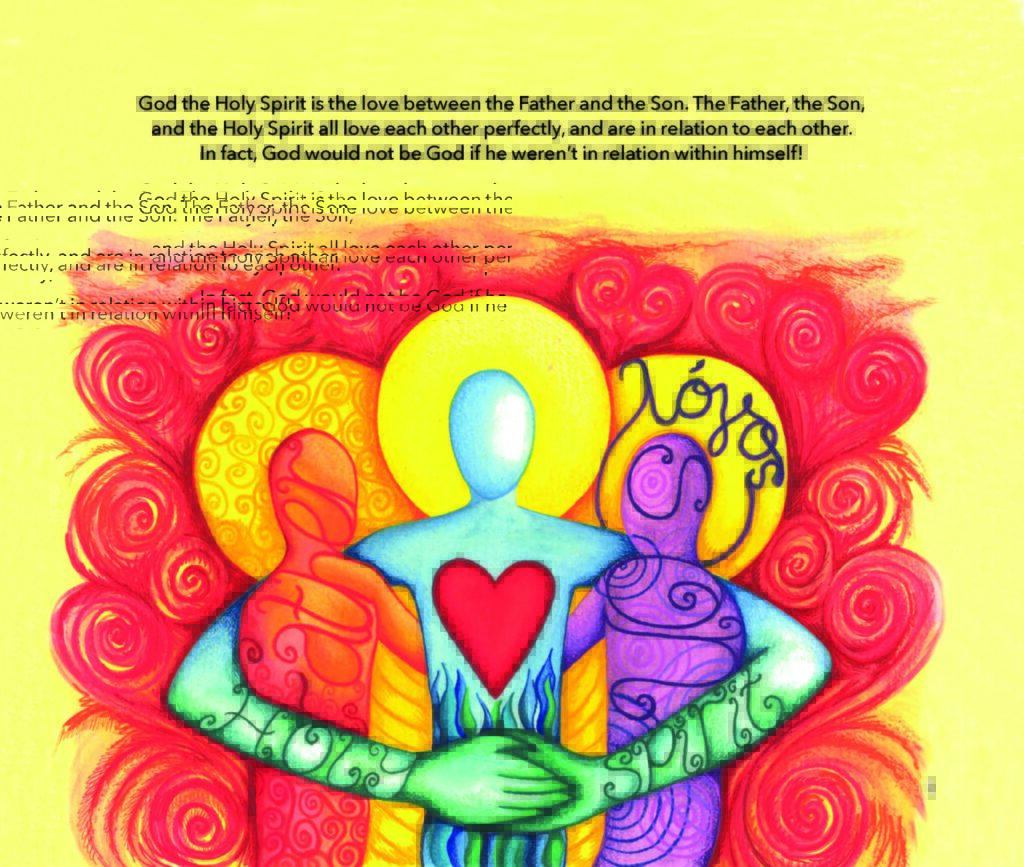
God the Holy Spirit is the love between the Father and the Son. The Father, the Son, and the Holy Spirit all love each other perfectly, and are in relation to each other. In fact, God would not be God if he weren’t in relation within himself!
5A.
This is not really an adequate description of the Holy Spirit, but nothing is! Again though, the key point being made is that God is love. He is not a thing or a human.
5B.
This page is also making the important point that relation is of God’s essence; God simply wouldn’t be God if he weren’t the Father, the Son, and the Holy Spirit, all in a perfect loving relationship with each other.
To explain a bit further: in Christian theology, though stemming from the philosophy of Aristotle, the term ‘essence’ means the fundamental nature of a thing. If a feature or attribute is of something’s essence, it means it is a characteristic that the thing or being must have, to be that thing, as opposed to being a different thing. For example, it’s part of the essence of a triangle to have three sides. If you had a shape with fewer or more than three sides, you wouldn’t have a triangle. A term that goes along with ‘essence’ is ‘accident’. In Christian theology, the term ‘accident’ refers to a feature a thing might or might not have, which doesn’t affect what the thing is. To go back to the triangle example: if you had a blue triangle and then you added some red and made it a purple triangle, either way you’ve got a triangle. You haven’t changed the essence of it – you haven’t changed what the shape is. You’ve only changed the accident of its colour.
So, to bring this back to God: it is of God’s essence to be in relationship. The relationship within God – the relationship between the Father, the Son, and the Holy Spirit – is of God’s essence. It is not only ‘accidental’. Perfect loving relationship is part of who God is, and not just a nice feature of God that may or may not have been.
5C.
This is important because it helps us to understand who God is. It also helps us to understand who we are too, because we are made in God’s image, and so we too are relational beings. Part of what it means to be human is to be in relationship.