
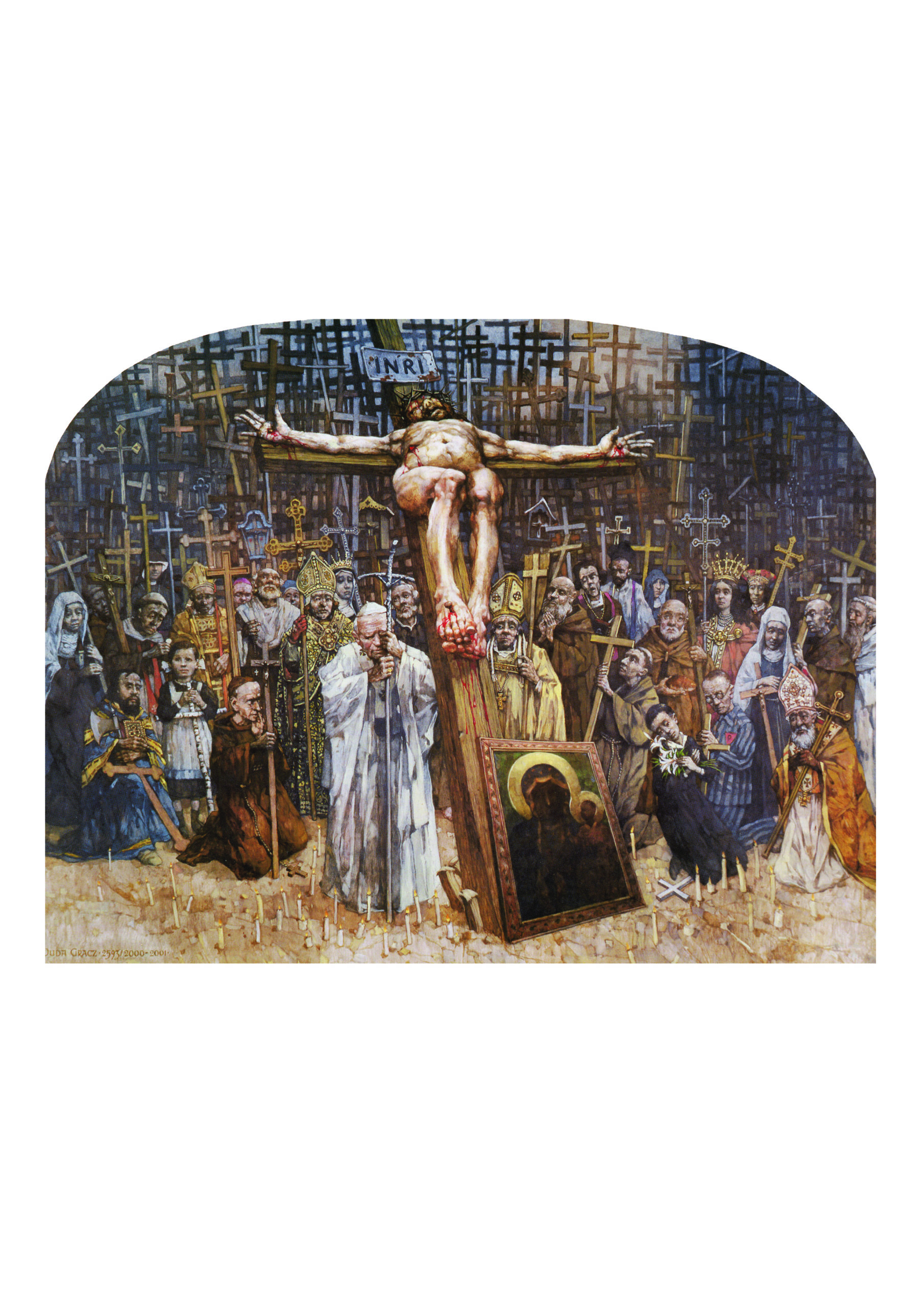
At the beginning of the third Millennium the monastery of Jasna Góra at Czestochowa in Poland commissioned a new set of Stations of the Cross by the local born artist Jerzy Duda Gracz. The work, completed and gifted to the monastery in 2001, three years before his death, Gracz considered the culmination of his artistic achievement and of his own spiritual life journey. Now installed in the same complex that houses the Icon of Our Lady of Czestochowa, the Golgotha comprises eighteen panels, the familiar fourteen Stations, plus four more – the Resurrection, the Confession of faith of St Thomas, the Commissioning of St Peter and the apostles, and the Ascension. It is a massive work, each panel measuring c. 6ft high by 4ft wide.
In any Stations of the Cross it is the twelfth portraying Christ’s death that is the climactic Station, the one where the words of the liturgy cease while the people kneel in silent meditation. This prominence is reflected in the Golgotha, whose twelfth Station panel is twice as large as the others (the same height but twice the breadth). It is to be seen as the central image of the whole work (above).
*
Though this panel stands out from the rest, it shares many of the characteristics of them all, for the whole has a coherence and a unity.
So for instance, its predominant colours are the sombre browns and greys of death, and this is the case in all the first fourteen.
Again, as in all the other Stations the bystanders witnessing the events are real people, contemporary or from the recent past, many of them recognisable – we will meet some of them in the pages below. They tell us that the Crucifixion is not merely an event of long ago, but one that throughout the centuries has been now, for us, and remains so today. By a nice play, the Apostle John at the foot of the Cross is John Paul II, the serving pope at the time of the Golgotha’s creation.
Another characteristic running through the Stations is the apartness, the loneliness of Jesus. As we shall see, in only two of the eighteen does any of the bystanders actually touch Him. The artist himself pointed out the importance of this theme in his work: Jesus, man and God, suffers alone and in ways we cannot conceive; and the crowds, even those who believe in Him, seem to stand aside, often uncomprehending, or indifferent, or too busy. These modern people are like us. They prompt the pilgrims who come to pray the Stations to examine their own conscience and to question their own Faith in practice.
Again, note how Mary is shown beside the Cross not as a living person but as her own portrait, as Our Lady of Czestochowa, a device that the artist also uses in stations 4, 8 and 13, and also slightly differently in 11. The icon depicts her with the infant Jesus, so that station 12 encompasses the entire life of Christ from birth to death, telling the viewer that His whole life was a giving, leading to the ultimate giving on Calvary. Furthermore, this icon is of huge significance in Poland; it represents the country’s Faith down the centuries, so that its use in station 12 tells us that Calvary has always been close to the soul of the Polish people.
This points to another characteristic common to all the Stations. Their focus is national. They are peopled by Polish men and women, and depict events and persons of Polish history, and especially of the nation’s afflictions in the final century of the second Millennium, the marks of which remained at the time of their composition. The artist himself remarked of his work, ‘this Golgotha is present today, now and here, in Catholic Poland’.
Nonetheless, though the subject of each Station is always a particular affliction, usually from an identifiable time and place in Poland’s recent history, it is at the same time universal. The particular sufferings of recognisable persons are also the sufferings of Everyman, and of Alltime.
Everyone in the crowd in station 12 is carrying a cross, including John Paul II who carries his familiar crucifix-shaped pastoral crozier. They are expressing solidarity with Christ. Stretching into the distance behind them the background is filled with crosses. These are the crosses of all humanity. They tell us that suffering is part of life, and that it is for the Christian to try to unite one’s sufferings to the sufferings of Christ, who Himself told us that those who wish to follow Him must deny themselves and take up their cross daily.[1] The acceptance is two-way: we unite our sufferings to Christ; He is close to us and the sharer of our sorrow; He bears our suffering, and in His Passion unites His suffering to ours.
*
Each of the Stations amplifies and particularizes this theme. So for instance in station 5 Simon of Cyrene appears as the artist himself in his studio work clothes, helping to carry the cross. He seems to say, ‘Yes, me too. I also am like the rest, often uncomprehending or indifferent or too busy. But I, like you, must carry the cross.’
Perhaps our suffering is the result of an accident, or sickness, or disability. So in station 2 we see an old man in a wheelchair, and a crippled man begging, while the whole background is a mass of the crutches of all those who are crippled, whether in body or mind. In station 4 Jesus meets His afflicted Mother. But here again, as in 12, she is not a living woman but her own portrait carrying her Son. Beside her are several young children, and behind her scores of similar portraits held aloft. These are all the world’s women who have lost children or who have had to watch helplessly as their children suffer.
We are not shown the cause of the suffering in these two Stations. Some, no doubt, are innocent – simply the result of misfortune. But others have perhaps come about through man’s doing, through the actions of others or their failure to act. So in the first station Jesus stands before Pilate, who is about to wash his hands of the whole affair. The Governor is blindfolded, blind to what is happening, or turning a blind eye. His attire is very like that of a modern day senior churchman. Similarly in station 3 (‘Jesus falls for the first time’), while angels weep and pray seven bishops or archbishops are sitting by in comfort.
If these two stations portray the pain caused by indifference and a failure to act, others show us suffering as the result of evil, of sheer wickedness. Perhaps the most disturbing of these is station 9 – ‘Jesus falls for the third time’ (image 2. 1 in the book).
This image is of victims of child abuse in its different forms. In the right background two toddlers look out over the bars of their cots as if out of the bars of a prison: they have been shut away and abandoned in ‘care’ homes. Above them a small child plays on a car tyre and seems about to use the Cross as part of a makeshift playground. He is one of the street children of the great cities. In the left middle ground are semi-naked girls, seeking to hide their nudity while urged forward by a Satanic adult; these are the victims of child pornography and prostitution. In front of them lie babies, either aborted or perhaps the victims of war or massacre. In the centre of the panel a young recruit follows a seasoned soldier as they creep forward to face the enemy. He is older than the other children, but still probably a minor, a child forced to take up arms. In the background children are seen climbing ladders. They are trying to escape. But perhaps the artist is also suggesting that this is a ladder to heaven, and that these Holy Innocents are mounting straight to eternal life.
At the foot of the panel, and the focus of the whole composition, Jesus lies having fallen again under the weight of all this wickedness, exploitation, suffering and pain. He appears to be weeping, for He is grieving for these children, and for all such children in all the places in the world ‘where God weeps’ for lost innocence.[2]
The extract above is taken from Images of the Cross by John Watts OFS, pages 19–24, published by Franciscan Publishing, Ash Wednesday, 5 March 2025. You can view the book here
[1] Luke 9:23; see also Luke 14:27 and Matthew 16:24.
[2] ‘Where God Weeps’ is the English title of a book written in 1969 by Fr Werenfried von Straaten, founder of the charity Aid to the Church in Need, concerning the sufferings of Christians in different parts of the world.