


£29.95
This peer reviewed anniversary volume offers a contribution to the wider anniversary celebrations taking place throughout the Franciscan world from 2023 to 2026. In the many diverse chapters we learn about the great successes and celebrations of the Franciscan mission, as well as the hardships and adverse circumstances endured by men and women of faith in their endeavour to follow the Gospel Christ. The tremendous contribution of Franciscan saints and scholars — so many of whom hailed from these shores — to the intellectual and spiritual tradition of the Franciscan School, is also explored, as is the charism’s contemporary relevance.
Hardback 532 pages. Published September 2024.
As a small business we rely on word of mouth recommendations to assist others in their choice of books. Please consider leaving a review of any of our books and so help us in our mission to promote books on Franciscan theology and spirituality. Thank you.
In order to leave a review you will need to log in to your account and go to the product page where you can click on the review tab to leave your comments
The world-wide Franciscan family is celebrating 800 years since the final phase of St Francis’ life, a very intense time during which we see St Francis grow into his full stature, both as a man and as a Christian. It is not by chance that the first Franciscan mission to England took place in 1224 or that it falls exactly within this unique period in the life of the Poverello. It marked the beginning of a period of great growth and influence for the Order in this country. The Franciscan brothers were able to establish an enduring presence, contributing significantly to the religious, intellectual and social life of mediaeval England. To commemorate 800 years since the arrival of the Friars Minor in England just when we are celebrating the Franciscan Centenary, shows us once again the light and the power of that Centenary. The memory of Father Eric Doyle OFM, on the fortieth anniversary of his death, makes this publication even more significant. I sincerely hope that it will provide an opportunity to revisit these events and also, in the light of a master of the calibre of Father Eric, rediscover their message and inspiration for our own time. This inspiration is truly different and new but it awaits a new breath of life and hope.
From time to time the Lord raises up a prophet in our midst. I feel that Eric was such a person — he was truly God’s spokesperson. He combined deep learning with a wide vision. He conveyed the message with irrepressible humour and huge enthusiasm. At the same time his Franciscan spirituality permeated his whole thinking. It seems so appropriate, therefore, that these essays celebrating 800 years of Franciscans in the British Isles should be in his honour. I feel sure this collection of outstanding and wide-ranging essays will bring inspiration and new insights in the present as much as in the past.
Eric Doyle OFM (1938–1984) was a Friar of the Province of the Immaculate Conception in Great Britain. A gifted scholar, theologian, orator and writer, his prime concern was always to bring the Franciscan message to the world at large, a task at which he excelled. These hitherto unpublished talks offer something for everyone interested in Franciscan Spirituality, be they Religious, Secular Franciscans or others. The Franciscan Christology which Doyle so ably elucidates is not only for Franciscans and the Church, but indeed for the ‘universal friary’, as he called it.
Born in Bolton on 13 July 1938, the son of a mill-worker, Martin William Doyle was educated at St Joseph’s R.C. primary school and then, having obtained an academic scholarship, at Thornleigh Salesian College. He entered the Order of Friars Minor at the age of 16, having been inspired to do so by a book on the life of St Francis (probably G. K. Chesteron’s Francis of Assisi). He made his solemn profession the day after his twenty-first birthday and was ordained to the priesthood on 16 July 1961. This was followed by studies in Rome, 1962-64, where Doyle trained as an ecclesiastical historian and where he received his doctorate summa cum laude.
Inspired by the Second Vatican Council, Doyle was at the forefront of the renewal process and was tireless in his efforts to put the teaching of the Council into practice. The breadth of Doyle’s learning was immense and his vision wide, so that he brought astute and far-sighted observations to bear on many areas of theology including Christology, Ecclesiology, Franciscan Spirituality, Ecumenism, Ecology, Eschatology and Religious Life. He was a founding father of the Franciscan Study Centre in Canterbury, where he introduced Franciscan Studies, and a pioneer of the newly established ‘group-style’ of community living there. He lectured at home and abroad, gave many retreats (principally to priests and religious), took part in ARCIC I debates, and made over 500 programs for Anglia TV’s The Big Question and BBC Radio 4’s Prayer for the Day. He was a participant at the Second Scotistic Congress in Oxford/Edinburgh, at the first International ‘Terra Mater’ Seminar in Gubbio, an International Bonaventurian Congress in Rome, as well as numerous conferences on the work of Teilhard de Chardin, of which Association he was also vice-president. In addition, his enormous capacity for work enabled him to publish over 100 articles and two books during the course of his career.
Recognized as an international scholar and lecturer, this theological multi-tasker’s focus was always on the present moment, ‘doing theology’, because standing as he did in the Franciscan intellectual tradition, theology of necessity always included a practical dimension, and for Doyle, also demanded contemporary relevance. Much of his work was ahead of its time, prophetic even. Doyle was a humble and self-effacing man who did not seek his own aggrandizement; his was always a life of service. Extremely likeable and memorable, his irrepressible character, gentle humor and great kindness won him many friends and admirers, including some amongst the hierarchy of both the Catholic Church and Anglican Communion. A gifted speaker, he became the first Roman Catholic to address a huge congregation in Canterbury Cathedral since the Reformation.
After Doyle’s sudden death at the early age of 46, Conrad Harkins OFM commented:
Friends of St Francis throughout the English-speaking world, to whom perhaps he was most familiar, know that in Eric’s transitus has departed one of the most vibrant Franciscans of this century. Doyle was buried at the Friary in Chilworth on 31 August 1984 where the church was full to overflowing, and where over 100 priests concelebrated his Requiem Mass.
You must be logged in to post a review.


The Rt Red Dominic Walker OGS, former Bishop of Monmouth –
Review in The Church Times
13 December 2024
ON 10 September 1224, nine Franciscan friars arrived on the British shores. They had been sent on a mission by St Francis just two years before he died, and their arrival marks 800 years of Franciscan life, ministry, and scholarship in Britain before, during, and after the Reformation, until today. This volume of essays celebrates this milestone and also honours the memory of Fr Eric Doyle, a Franciscan scholar who died unexpectedly, 40 years ago, aged 46.
The essays are by 19 Roman Catholic and Anglican scholars, and also included are contributions from Doyle, whom Bishop Thomas McMahon described as a man who ‘put profound truths in a simple way and conveyed always a sense of the numinous; the holy, the wonder of God and his world; vivid, articulate, deeply learned, intensely human, hugely alive, full of mischief, unsparing of self — a contemporary Francis. His Franciscan spirituality permeated his total thinking.’
The various writers outline the development of Franciscan life in England, where one of the friars, John Pecham, served as Archbishop of Canterbury, and also in Scotland, Ireland, and Wales. Their growth in popularity owed much to the admiration of the local people and the financial support of the wealthy. Although Franciscan friaries were among the first to be suppressed at the Reformation, and many friars were killed or imprisoned, they returned in the 17th century.
Although the Friars Minor are regarded primarily as missionaries, there is also a distinctive Franciscan teaching tradition sometimes described as ‘the other orthodoxy’ and taught by such British scholars as John Duns Scotus, Roger Bacon, William of Ockham, and William Woodford. The most notable is Duns Scotus, who wrote on the primacy of Christ, the physics of light, Christology, and the Immaculate Conception. In 1973, the Franciscan Study Centre was opened in Canterbury to promote the Franciscan intellectual and spiritual tradition, but, sadly, the decision was made to close it in 2017.
This volume contains interesting essays about St Clare of Assisi and her leadership and the development of the Franciscan charism in both conventual and secular orders. There is also a critical study of the legend of St Francis kissing the leper. There are essays on ecumenism and the development of Franciscan life within the Anglican tradition as lived today by the friars, Sisters, and Poor Clare nuns and members of the Third Order of the Society of St Francis.
These essays are largely concerned with the past 800 years and the huge contribution that the Franciscans made, particularly in the Middle Ages, but they nevertheless also point to the future and provide encouragement and inspiration for those who today still feel called to live the gospel life in the spirit of St Francis.
A Poor Clare nun writes: ‘The Franciscan movement has always been “edgy”. It was impossible to tie Francis down. You could not label him as either contemplative or apostolic. He had intense times of prayer and solitude as well as intense times of service and apostolate. He remained always faithful to the traditions of the Church but his heart and mind were open to new and different possibilities. . . Everything is in a state of flux. . . We need not be afraid of change but keep our gaze on the one who calls us to live and love.’
The Rt Revd Dominic Walker OGS is a former Bishop of Monmouth.
Br Nicholas Alan SSF, Guardian of Glasshampton Monastery –
Published in Franciscan, May 2025
On 10th September 1224, in the same month that St Francis had a vision of the crucified Christ in angelic form and received in his own body the stigmata, the wounds of Christ, a small group of Franciscan Friars landed in Dover. While Francis was in deep retreat on Mount Alverna in Umbria, his brothers were already taking his message of peace and reconciliation to the farthest reaches of Europe. Led by Agnes of Pisa, this handful of men began their mission in Canterbury, then moved on to London and Oxford, and so to the rest of the British Isles. This wide-ranging collection of essays commemorates this event with chapters on the history and charism of the Franciscan movement, its intellectual and spiritual tradition, and ends with a section on Franciscan ecumenism.
The historical section covers the initial growth of the First Order in England, Ireland, Scotland and Wales, leading into some reflections on the Second and Third Order Regular communities, and a history of the Secular Franciscan order. Themes explored in this section include the place of Marian devotion among the early Franciscans, and the vexed question of the nature of enclosure in St Clare’s Form of Life, thus raising the question of how monastic her community really was. Particularly interesting is the chapter on the evolution of the story of St Francis and the embrace of the man with leprosy, such a pivotal moment in Francis’ own spiritual journey, as witnessed in his Testament. Examining how the story is treated differently by each of the Legends, the different versions are shown to help evaluate their respective dates and their influence on each other, and show how theology becomes narrative and story emerges from event.
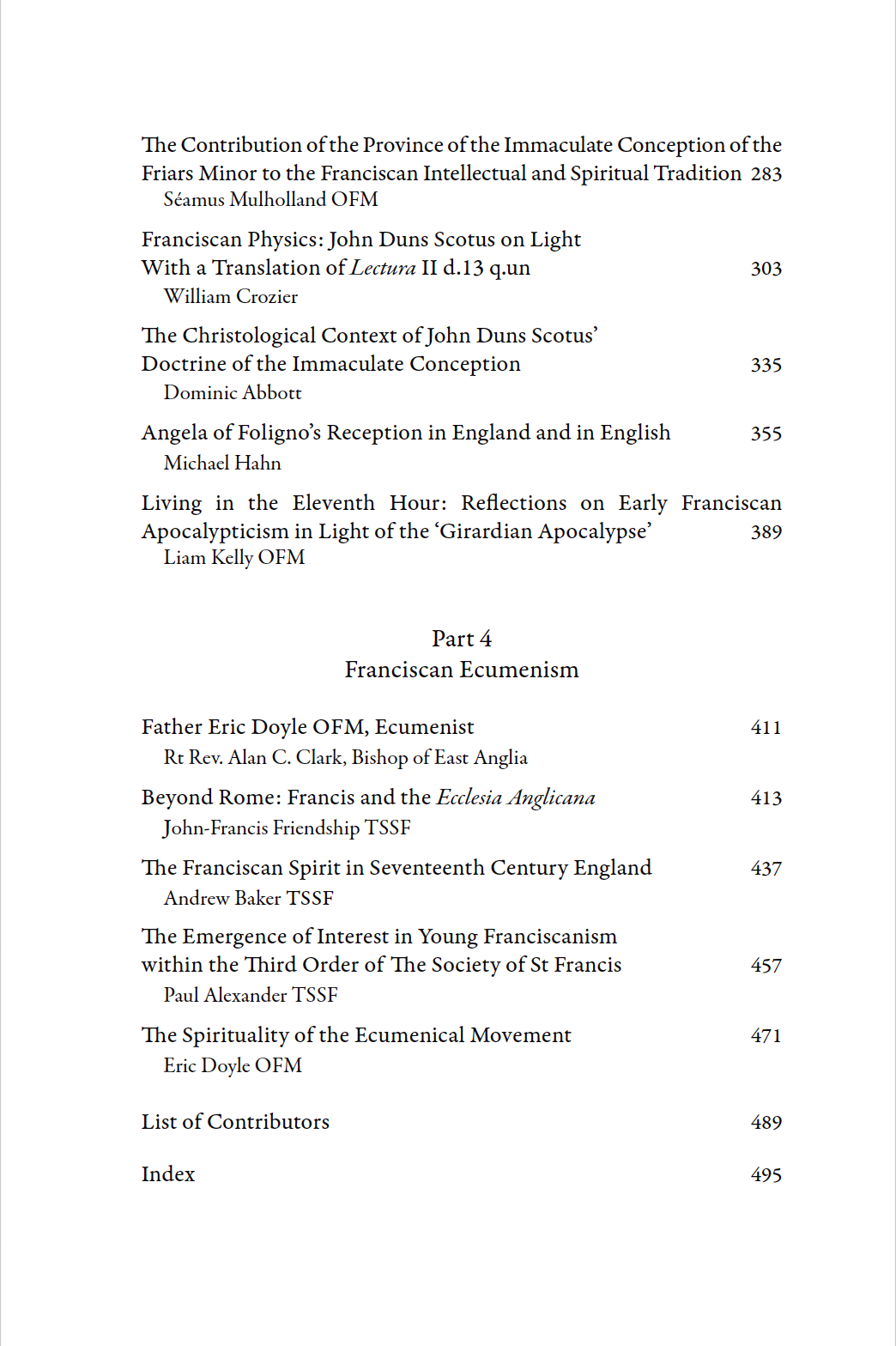
The section on the Franciscan intellectual and spiritual tradition goes on to explore teachings by Franciscan theologians such as John Duns Scotus on the physics of light and the doctrine of the Immaculate Conception. Another interesting chapter covers the reception of Angela of Foligno in England and in English, including a reflection on a recent book called Seeing Differently.
Finally, the section on Franciscan Ecumenism includes three essays written by the members of the Anglican Third Order of the Society of Saint Francis. These cover the Franciscan spirit in 17th century England, the contemporary emergence of interest in establishing young Franciscanism and an extensive account of the Anglican Franciscan communities.
The book is subtitled ‘Essays in honour of Eric Doyle OFM (1938–1984)’ and carries short pieces by him as introductions and summaries of each section. This gives the volume as a whole a profoundly elegiac air, with obvious sadness at the early death of significant Friar theologian. Connected with this is a sense of bereavement at the loss of the Franciscan International Study Centre founded in Canterbury in 1973 and closed in 2017.
As with any collection of essays this book both indicates the breadth of Franciscan studies, and encourages further detailed study and research. Highly recommended.
Br Nicholas Alan SSF, Guardian of Glasshampton Monastery